2 posts tagged with "mcp"

View All Tags

Agent Runtimes: Build AI Agents That Connect to Everything

· 6 min read
Eric Charles
Datalayer CEO/Founder

Today we're excited to announce significant enhancements to Agent Runtimes — our open-source framework for building AI agents that can connect to any tool, any model, and any interface.

Agent Runtimes

The Challenge: AI Agents Need More Than Just a Model

Building useful AI agents requires more than connecting to an LLM. Your agents need to:

  • Search the web for up-to-date information
  • Access files and databases in your infrastructure
  • Execute code and interact with APIs
  • Present rich interfaces to your users

Until now, wiring all these capabilities together meant writing custom integration code, managing complex lifecycles, and handling failures gracefully — a significant engineering investment.

Industry-Standard Transport Protocols

One of the biggest challenges in the AI agent ecosystem is fragmentation. Every framework uses its own protocol, making it hard to build interoperable systems. Agent Runtimes solves this by supporting all major transport standards out of the box:

AG-UI — CopilotKit's Agent Protocol

AG-UI (Agent User Interaction Protocol) is CopilotKit's open standard for agent-frontend communication. It provides a unified way for agents to stream responses, handle tool calls, and manage conversation state.

Vercel AI SDK

The Vercel AI SDK has become the go-to choice for building AI-powered applications in the JavaScript ecosystem. Agent Runtimes implements the Vercel AI streaming protocol, so you can use familiar patterns and tools.

ACP — Agent Communication Protocol

ACP is IBM's WebSocket-based protocol designed for real-time, bidirectional agent communication. Ideal for scenarios requiring persistent connections and low-latency interactions.

A2A — Agent-to-Agent Protocol

A2A is Google's protocol enabling agents to discover, communicate, and collaborate with each other. Build multi-agent systems where specialized agents work together on complex tasks.

Why This Matters

No vendor lock-in. Switch between protocols without rewriting your agents. Start with Vercel AI for a quick prototype, then add A2A when you need multi-agent collaboration.

Ecosystem compatibility. Your agents work with the tools and frameworks your team already uses — CopilotKit, Vercel AI SDK, or custom implementations.

Future-proof architecture. As new protocols emerge, Agent Runtimes adopts them, keeping your investment protected.

Rich UI Extensions: A2UI, MCP-UI, and MCP Apps

AI agents shouldn't be limited to text-in, text-out interactions. We've added three extension protocols that enable rich, interactive experiences:

A2UI — Agent-to-UI Communication

Enable your agents to send structured UI updates and receive user inputs in real-time. Perfect for building chat interfaces that need progress indicators, form inputs, or interactive elements.

MCP-UI — Browse and Execute Tools

Give users a visual interface to explore available MCP tools, understand their parameters, and see execution results. Great for debugging and building trust in agent behavior.

MCP Apps — Full Application Experiences

Following the MCP Apps specification, your MCP servers can now serve complete application experiences — dashboards, forms, and multi-page flows — not just API endpoints.

First-Class MCP Support

Model Context Protocol (MCP) is quickly becoming the standard for connecting AI agents to external tools. With this release, Agent Runtimes provides production-ready MCP integration out of the box.

What This Means for You

Zero-configuration tool access. Add tools like Tavily search, LinkedIn data, or custom MCP servers in ~/.datalayer/mcp.json:

{
"mcpServers": {
"tavily": {
"command": "npx",
"args": ["-y", "tavily-mcp@0.1.3"],
"env": {
"TAVILY_API_KEY": "${TAVILY_API_KEY}"
}
},
"linkedin": {
"command": "uvx",
"args": [
"--from",
"git+https://github.com/stickerdaniel/linkedin-mcp-server",
"linkedin-mcp-server"
]
}
}
}

For LinkedIn, create a session file first:

# Install browser
uvx --from playwright playwright install chromium

# Create session (opens browser for login)
uvx --from git+https://github.com/stickerdaniel/linkedin-mcp-server linkedin-mcp-server --get-session

Reliable under pressure. MCP servers are managed with automatic retry logic, exponential backoff, and health monitoring. If a server fails to start, Agent Runtimes retries up to 3 times before gracefully degrading — your agents stay responsive even when external services hiccup.

Real-time visibility. Check MCP server status anytime via the API:

curl http://localhost:8765/api/v1/configure/mcp-toolsets-status
{
"initialized": true,
"ready_count": 2,
"total_count": 2,
"servers": {
"tavily": { "ready": true, "tools": ["tavily_search"] },
"linkedin": { "ready": true, "tools": ["get_person_profile", "get_company_profile"] }
}
}

A Complete REST API

Every capability is exposed through a clean, documented REST API:

What You Want to DoEndpoint
List available agentsGET /api/v1/agents
Send a prompt (streaming)POST /api/v1/agents/{id}/prompt
Check MCP statusGET /api/v1/configure/mcp-toolsets-status
Get agent detailsGET /api/v1/agents/{id}

Interactive API documentation is available at /docs (Swagger) and /redoc when you start the server.

Getting Started in 5 Minutes

# Install Agent Runtimes
pip install agent-runtimes

# Set your API keys
export ANTHROPIC_API_KEY="sk-ant-..."
export TAVILY_API_KEY="tvly-..."

# Start the server
python -m agent_runtimes

That's it. You now have a production-ready AI agent with web search capabilities, accessible via REST API or our React UI components.

What's Next

We're continuing to expand Agent Runtimes with:

  • More MCP server integrations — databases, file systems, and enterprise tools
  • Agent-to-Agent (A2A) communication — let agents collaborate on complex tasks
  • Enhanced observability — tracing, metrics, and debugging tools

Join the Community

Agent Runtimes is open source and we'd love your contributions:

Build AI agents that connect to everything. Build with Agent Runtimes.

  Datalayer: AI Agents for Data Analysis Register and get free credits

JupyterCon 2025: Presenting Jupyter MCP Server

· 4 min read
Eric Charles
Datalayer CEO/Founder

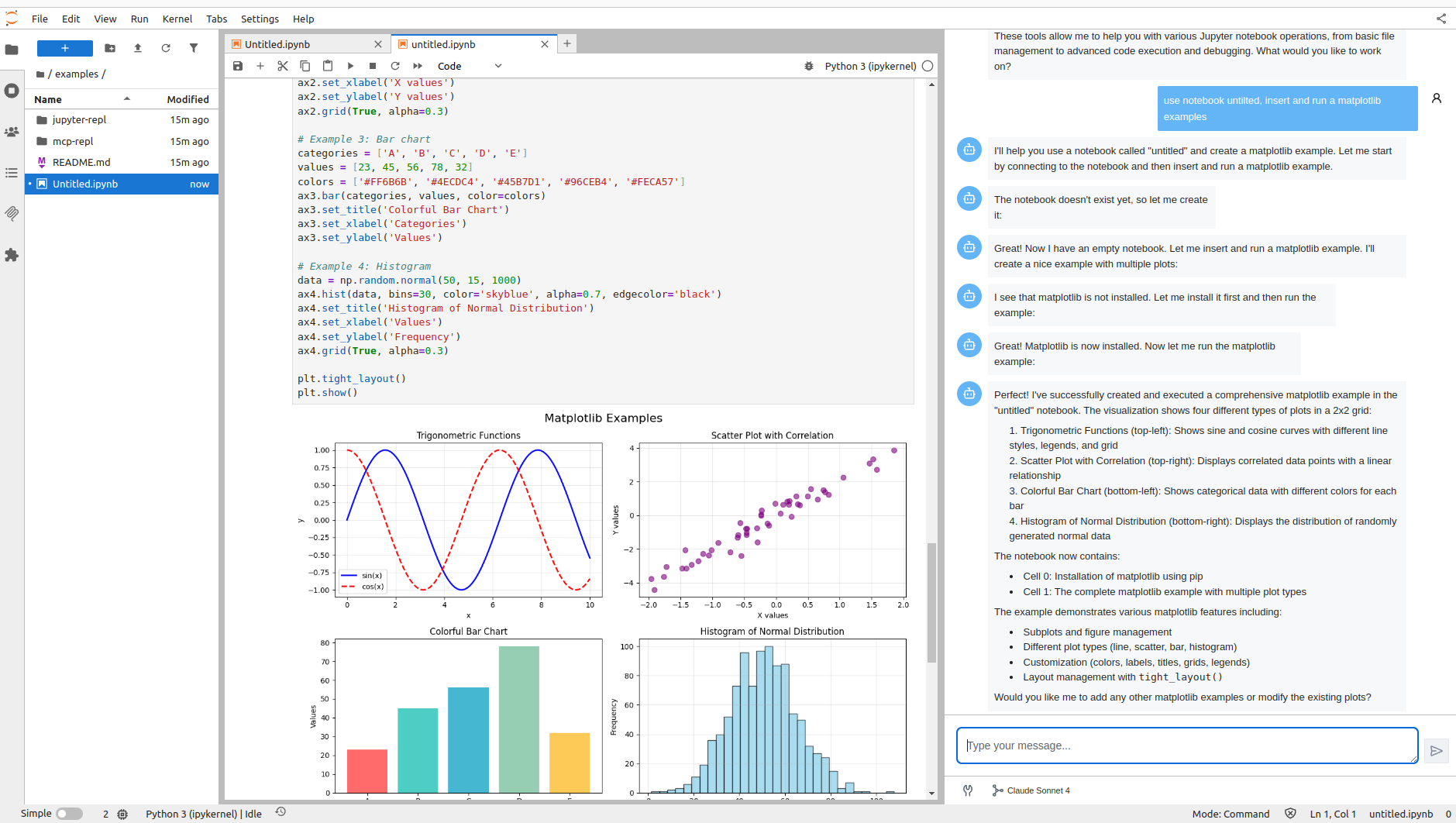
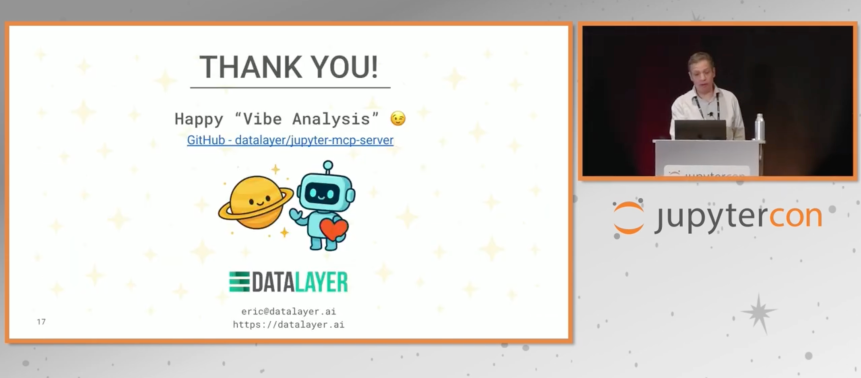
I recently had the privilege of presenting at JupyterCon 2025, where I shared our work on the Jupyter MCP Server that aims to standardize how AI agents interact with Jupyter notebooks through the Model Context Protocol (MCP).

JupyterCon 2025 Presentation on Jupyter MCP Server

The Challenge: AI Agents Need Better Jupyter Integration

As AI agents become increasingly capable, they need more sophisticated ways to interact with the applications that data scientists already use every day. Jupyter notebooks are at the heart of the data science workflow, but until the MCP release, there hasn't been a standardized way for AI agents to seamlessly access and manipulate notebook environments.

Introducing the Jupyter MCP Server

The Model Context Protocol (MCP), introduced by Anthropic, provides a standardized way for AI agents to connect to external systems and data sources. Our Jupyter MCP Server extends this protocol to create a bridge between AI agents and Jupyter environments, enabling:

  • Standardized notebook access: AI agents can read, write, and execute notebook cells through a well-defined protocol
  • Kernel management: Direct interaction with Jupyter kernels for code execution and state management
  • File system operations: Access to notebooks, data files, and other resources in the Jupyter environment
  • Real-time collaboration: AI agents can work alongside human data scientists in the same notebook environment

You can watch my complete JupyterCon 2025 presentation here:

Jupyter MCP Server is open source and available for the community to use and contribute to. Whether you're a data scientist looking to enhance your workflow with AI agents, or a developer building AI-powered data science tools, the Jupyter MCP Server provides the standardized foundation you need. You can find the project on GitHub.

Conclusion

JupyterCon 2025 was an incredible experience, bringing together the brightest minds in the Jupyter ecosystem. Presenting the Jupyter MCP Server allowed me to share our vision for the future of AI-enhanced data science workflows and get valuable feedback from the community.

The enthusiastic response to the presentation confirms that the data science community is ready for this next step in AI integration. By standardizing how AI agents interact with Jupyter environments, we're opening up new possibilities for collaboration, productivity, and innovation in data science.

I'm excited to continue working with the Jupyter community to refine and expand the Jupyter MCP Server, making it an essential tool for the next generation of AI-powered data science workflows.


Want to learn more about the Jupyter MCP Server or get involved in its development? Visit our GitHub repository, join our Discord server to connect with the community, or reach out to us to discuss how it can enhance your data science workflow.

  Datalayer: AI Agents for Data Analysis Register and get free credits