Pydantic Donating FastA2A to Datalayer

This article is cross-posted on the Pydantic blog: FastA2A is moving to Datalayer.
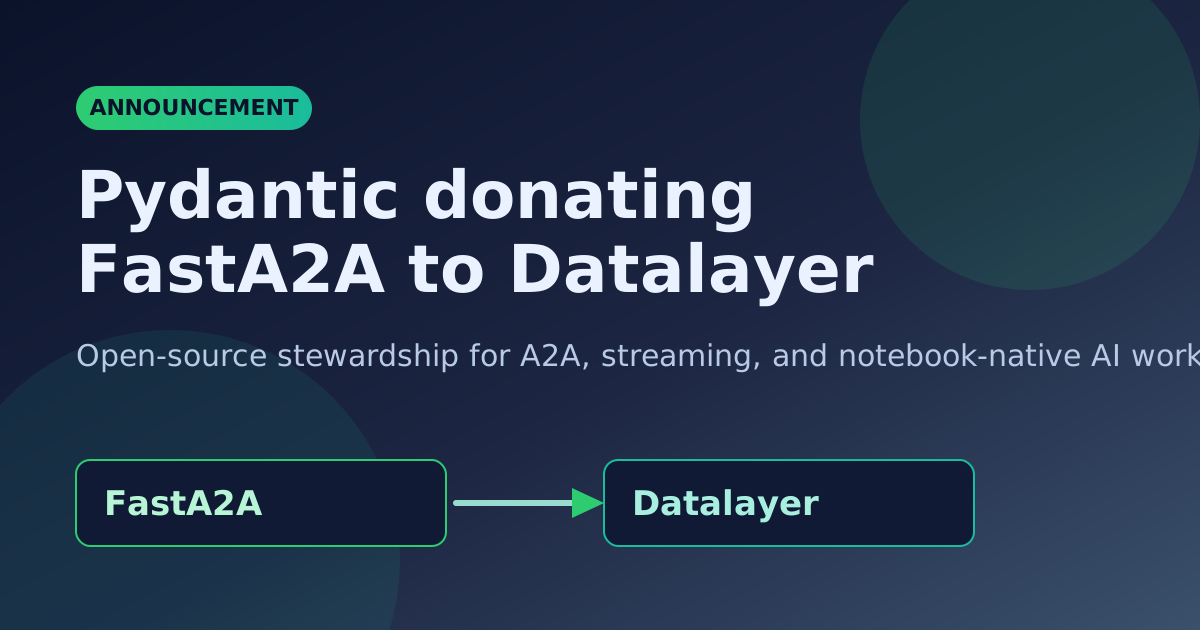
FastA2A Finds a New Home at Datalayer
The future of open agent-to-agent infrastructure is community-driven, and today we are excited to announce an important new chapter for FastA2A.
After a strong collaboration between Datalayer and Pydantic, the FastA2A repository will be donated by Pydantic to Datalayer, which will now maintain and evolve the project going forward.
This transition builds on an already successful partnership between Datalayer and Pydantic, including the recent addition of streaming support to FastA2A and earlier collaborations highlighted in the Pydantic + Datalayer case study.
The new repository location for FastA2A is github.com/datalayer/fasta2a.
Browse the code and updates on GitHub.
Why FastA2A Matters
As the AI ecosystem evolves, agent-to-agent communication is becoming foundational infrastructure.
FastA2A was created to provide a lightweight, developer-friendly implementation of the emerging A2A paradigm, enabling AI systems, tools, runtimes, and applications to communicate efficiently through structured protocols and streaming interactions.
The project has seen steady community adoption and growing interest from developers building:
- Autonomous agents.
- AI orchestration frameworks.
- Notebook-native AI workflows.
- Multi-agent systems.
- Interactive developer tooling.
Recent collaboration between Datalayer and Pydantic significantly improved FastA2A's streaming capabilities, an important step for real-time AI interactions and responsive user experiences.
Why Pydantic Is Donating the Project
Pydantic continues to focus heavily on its core strategic initiatives, including:
- Pydantic, the company.
- Logfire, the AI observability tool.
- Pydantic Validation.
- Pydantic AI (and newer Pydantic AI Harness).
- Pydantic AI Gateway.
- The broader developer tooling ecosystem around validation and AI engineering.
While FastA2A has proven valuable and promising, Pydantic does not currently see it as a flagship long-term component of its product strategy.
Rather than letting the project evolve slowly on the sidelines, Pydantic chose a path that benefits both the community and the technology itself: placing FastA2A into the hands of a team deeply invested in the future of A2A systems.
That team is Datalayer.
Why Datalayer
At Datalayer, agent interoperability is central to the company's vision.
A2A is already a key building block in the company's architecture and roadmap, particularly around:
- Generative user interfaces (A2UI).
- Notebook-native AI experiences.
- Jupyter-based execution sandboxes.
- Data Analysis agents.
- Collaborative AI workflows.
FastA2A naturally complements this direction.
By taking stewardship of the repository, Datalayer can align the project's evolution with real-world developer needs and emerging open standards while continuing to support the broader ecosystem.
What Changes, and What Doesn't
What stays the same
- FastA2A remains fully open source.
- The MIT license remains unchanged.
- Existing users can continue using the project freely.
- Community contributions remain welcome.
What changes
Datalayer will now:
- Maintain the repository.
- Drive new feature development.
- Prioritize community requests.
- Expand streaming and real-time capabilities.
- Integrate deeper A2UI concepts.
- Explore tighter integration with Jupyter execution environments and data workflows.
The goal is not simply maintenance. It is acceleration, in close collaboration with the Pydantic team who is still behind the work in a transition period.
🙏 Special thanks
Thank you Marcelo Trylesinski for all his effort maintaining the initial library and continuing support into this transition.
The Road Ahead
The future of AI infrastructure will not be built by isolated models alone.
It will be built through:
- Interoperable agents.
- Composable runtimes.
- Streaming interactions.
- Executable environments.
- Rich human-in-the-loop interfaces.
FastA2A sits directly at this intersection.
Datalayer is excited to continue investing in the project and helping shape the next generation of open agent communication infrastructure together with the community.
The Datalayer team is grateful to the Pydantic team for their trust, collaboration, and contributions to the project so far.
The next chapter of FastA2A starts now.